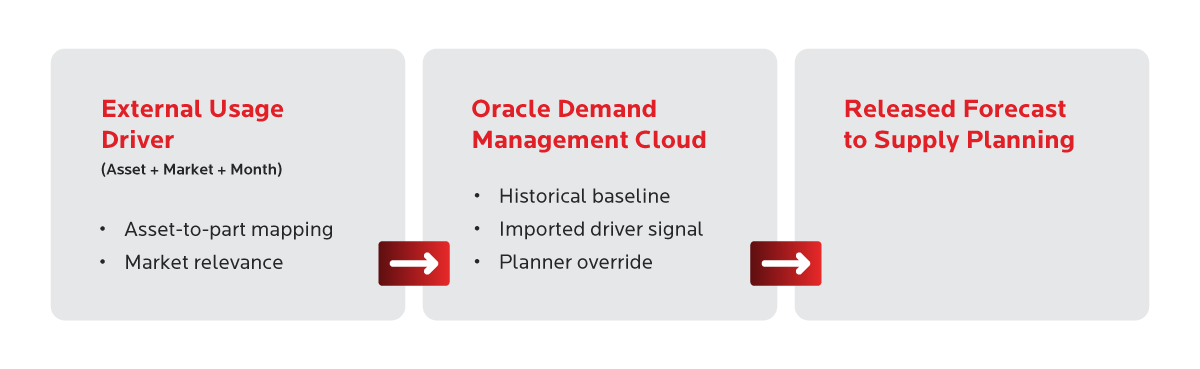

Oracle Fusion Cloud Demand Management (DM) is well-suited to act as the enterprise planning workbench because it supports demand plans, multidimensional analysis, statistical forecasting, planner adjustments, and demand shaping across multiple signals. Oracle Supply Chain Planning also supports loading external data and forecasts using standard file-based import processes.
The recommended design is a hybrid model: use Oracle DM for the baseline forecast, planner review, overrides, and final consensus release; use a PaaS or a governed external data layer to calculate operational-driver-based demand and resolve shared-part relationships across asset types and markets. This approach preserves Oracle’s standard capabilities wherever they add value while avoiding unnecessary complexity inside the planning engine.
Why this hybrid model is the better fit
Oracle Demand Management (DM) should remain the planning and decision layer
Oracle DM is designed to generate forecasts from historical demand, let planners compare signals, make overrides, and release a final forecast. That makes it the right place for forecast governance and business consensus.
The external driver should stay outside Oracle
It is recommended that future operational-driver calculations should be performed outside of Oracle Demand Management Cloud, in an external DB or PaaS layer. Keeping this logic external preserves ownership, reduces intrusive customization, and allows the model to evolve without redesigning the planning structure.
Many-to-many relationships are easier to manage outside the plan
Because parts can belong to multiple asset programs and relevance varies by market, the most maintainable approach is to resolve these relationships in the DB/PaaS layer above before loading demand into Oracle DM.
Spare parts forecasting process model
1. Historical consumption baseline in Oracle Demand Management (DM)
Use Oracle DM’s standard forecasting engine to create a baseline forecast based on historical spare parts consumption. This establishes the statistical anchor for routine demand.
2. External operational-driver calculation
Calculate asset/market usage forecasts outside Oracle on a monthly or S&OP-aligned cadence. This keeps specialized demand-signal logic in a more flexible data layer.
3. External mapping and allocation logic
Apply asset-to-part mapping using pBOM, part-to-market relevance, and allocation rules externally to convert driver signals into a clean part + market + month forecast input.
4. Planner-led consensus in Oracle DM
Load the externally prepared signal into DM, compare it with the history-based baseline, apply overrides, and release the final consensus forecast to downstream supply planning.