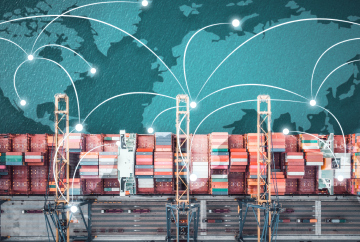

However, the world those models were designed for has changed significantly.
Although cost optimization will always matter, today's supply chain leaders must now balance a much broader set of priorities. Geopolitical uncertainty, changing trade policies, labor shortages, new regulations, and frequent disruptions make resilience just as essential as efficiency.
In fact, 74% of logistics leaders identify geopolitical tensions as their most significant supply chain risk, according to Reuters Events, while McKinsey reports that 82% of supply chain leaders say their operations are already being affected by new tariffs.
Some recent developments illustrate why this shift matters: disruption is now affecting both physical trade routes and commercial sourcing decisions simultaneously.
The Red Sea crisis in 2023 meant hundreds of container ships had to avoid the Suez Canal and take the much longer route around the Cape of Good Hope. Transit times jumped by up to two weeks, freight costs soared, and organizations had to rethink their inventory and production plans almost overnight.
In 2026, attention has shifted again, this time to another vital global trade corridor. The escalation of tensions between the United States and Iran has created renewed uncertainty around the Strait of Hormuz, a route through which roughly one-fifth of the world's oil and a significant proportion of global LNG exports pass. While the waterway remains open, increased military activity and security concerns have already affected shipping patterns, insurance costs, and energy price volatility, raising costs and complicating planning for manufacturers and logistics providers. Even the possibility of disruption creates ripple effects across transportation costs, supplier pricing, and production planning.
At the same time, changing US trade tariffs continue to reshape global sourcing strategies. Organizations are reassessing supplier locations, evaluating nearshoring opportunities, and modelling different procurement scenarios as tariff policies evolve. These decisions directly influence manufacturing footprints, inventory positioning, and long-term supply chain resilience.
But the impact goes far beyond just transportation.
A disruption in one part of the supply chain can quickly affect the wider business. Production schedules are delayed, customer commitments come under pressure, compliance risks increase, and financial performance can deteriorate. What begins as a geopolitical event or regulatory change can quickly become an enterprise-wide challenge.
This is why resilience is quickly becoming not just a competitive advantage, but a core capability for every business.
So how do we keep our organizations moving forward when supply chain disruption is no longer the exception, but part of our everyday reality?
Resilience, therefore, needs to be designed into the operating model, not treated as a one-off crisis response.
The answer lies in building a set of practical, repeatable capabilities:
- Better visibility across suppliers and logistics networks
- Scenario planning to evaluate alternative sourcing and manufacturing options
- AI-driven insights that help teams anticipate disruption earlier.
- Trade compliance capabilities that can adapt to changing regulations
- More connected planning across procurement, manufacturing, and logistics
Technology is a key enabler of this shift. Modern cloud platforms such as Oracle Fusion Cloud ERP, Oracle Supply Chain Management, Oracle Supply Chain Planning, and Oracle Transportation Management help organizations move beyond reactive disruption management and build more intelligent, connected supply chains.
By combining operational data with external signals such as geopolitical events, tariff changes, weather updates, port congestion, supplier risk, and transportation feeds, leaders gain a clearer view of what is happening across their supply networks.
AI can then turn these insights into practical recommendations. Rather than just reporting delays, AI can model different scenarios, predict knock-on effects, suggest alternative suppliers or routes, optimize inventory, and help planners weigh the financial impact of their choices before taking action.
This shifts decision-making from reactive response to proactive risk management, helping organizations act earlier and make faster, more confident decisions.
The supply chain leaders of tomorrow will be those who can adapt quickly, respond to changing tariffs without missing a beat, adjust sourcing as global events reshape trade routes, and keep serving customers even when supplies or transport are under pressure.