

We used Oracle's Fusion Setup and Configuration Registry (FSCR), a published library of AI skills and governed workflows for Fusion setup, through Codex in VS Code against an Oracle Fusion Demo environment. The input was a Customer Billing FRD for Vision Cloud Services (VCS), a fictitious subscription- and professional-services business, with 18 business requirements, 5 controls, and 7 acceptance criteria. Subscription billing is sourced from an external subscription system and imported into Fusion, while professional services invoices are entered manually. The FRD covers payment terms, invoice types, billing sources, invoice grouping, and remit-to addresses. Several issues were planted in the FRD; the agent was not told about them.
1. It translated requirements into a Fusion plan
FSCR translated the FRD into a task-and-dependency plan: the Fusion setup needed for each requirement, the relevant objects, and the dependencies between them. Execution was coordinated through a Run Book in Fusion, providing a task-level record of progress and supporting the governed load workflow.
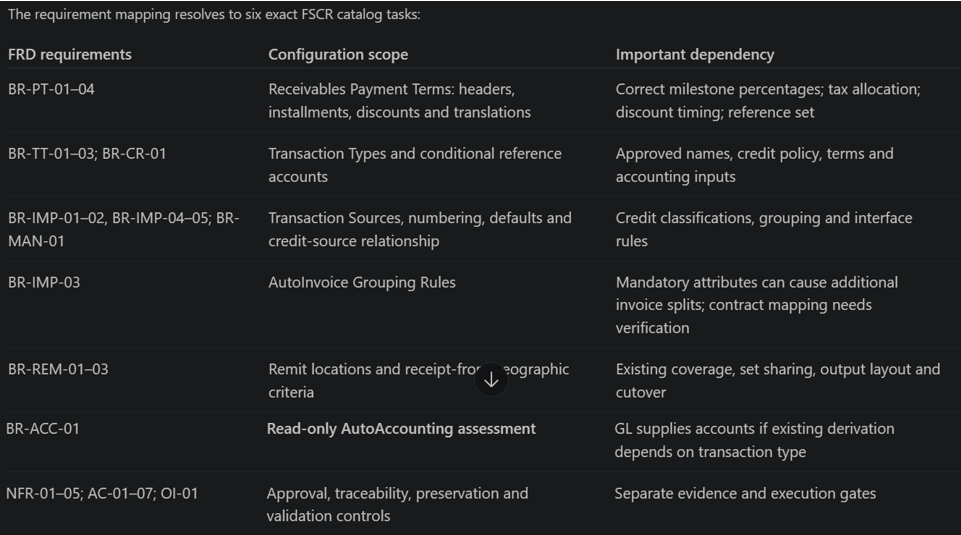
Figure 1. Requirements mapped to FSCR setup tasks, the configuration scope of each, and the dependencies to resolve.
Two examples from the plan show the kind of reasoning FSCR applied across all the requirements:
- Auto-Invoice grouping. The FRD asked for one invoice per bill-to site and per subscription contract, never combining different customer POs. The subscription system sends the contract number in the Sales Order field. FSCR recognized that bill-to-site and purchase order are already mandatory grouping attributes, so it added only Sales Order, for invoices and credit memos. It also flagged the limit: one contract's lines can still split if, say, currency or payment terms differ.
- Remit-to address. Which remit-to address prints on an invoice depends on assignments by customer location, and these are shared across the entire environment. FSCR checked the Phoenix address against the 74 addresses and 60 assignments already in Fusion and asked which reference data set to use (we chose Common). It then created the address and assigned it to the five western states named in the FRD, without overriding any existing assignment.
For each setup object selected for execution, FSCR exported the current setup from Fusion, generated the load file in the task's required format, and validated it against that format and the existing data.
2. It challenged the requirements before configuring anything
Before any configuration, FSCR set out the problems it found in the FRD, citing requirement IDs and Oracle documentation where they applied, so each could be corrected at source:
- An installment schedule adding up to 110% (30% + 40% + 40%). It also raised a question the FRD had not answered: does "milestone billing" mean installments on a single invoice, or separate invoices for each milestone? Those are different business outcomes? Those are different business outcomes.
- Two credit rules are in conflict: one allows invoices to be credited, and the other forbids it.
- A name that would not fit: "Professional Services Invoice" is 29 characters against a 20-character limit.
- A hidden dependency: partial payment discounts also depend on shared setup (a Receivables system option), so creating the requested payment terms and transaction types alone would not prove the required behavior.
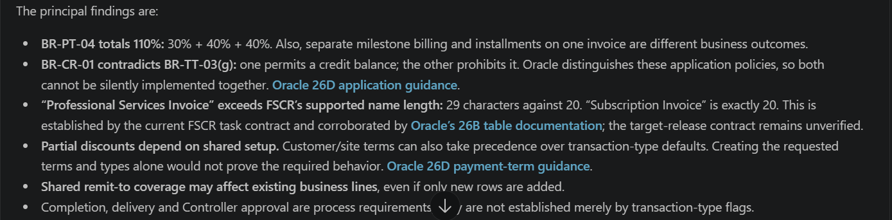
Figure 2. The agent's principal findings, with requirement references and links to the supporting Oracle documentation.
This was by design. Our opening prompt told the agent not to take the FRD at face value: check it against Oracle documentation, separate the customer's requests from how the product actually works, and recommend options for every open decision.
3. It asked for decisions instead of assuming
It turned unresolved requirements into a short, prioritized list of blocking decisions, each framed as a question with recommended options, and stopped there. It did not resolve contradictions quietly or invent values.
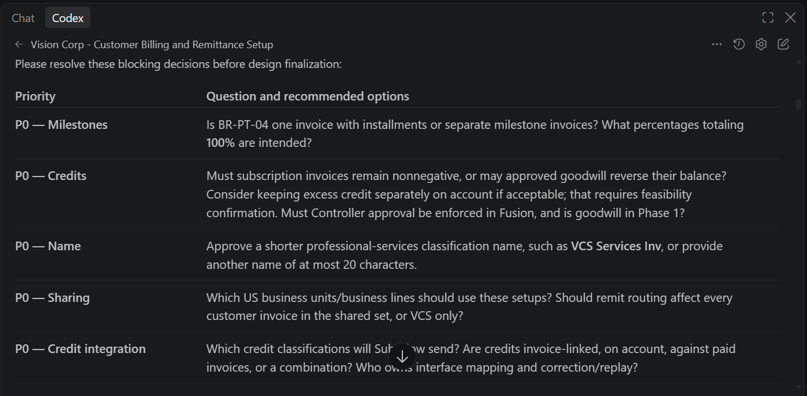
Figure 3. Blocking decisions, prioritized, with recommended options. The agent waits for answers before finalizing the design.
We answered as the customer would. Milestones: one invoice with a 20/40/40 installment schedule. Credits: natural application only, so an invoice cannot go into credit, and the conflicting goodwill requirement was rejected. We also set the 7 print lead days the FRD had left out. The agent set out the options; we made the decisions.
4. It configured and verified Fusion under control
Before each change, FSCR ran read-only preflight checks: package integrity, task-plan validity, and connection authorization. It then asked for approval of one exact, validated package, identified by its checksum, and loaded nothing until it had that approval. After loading, at our request, it did not stop at job success: it exported the saved setup and compared it with the approved package and the original baseline.
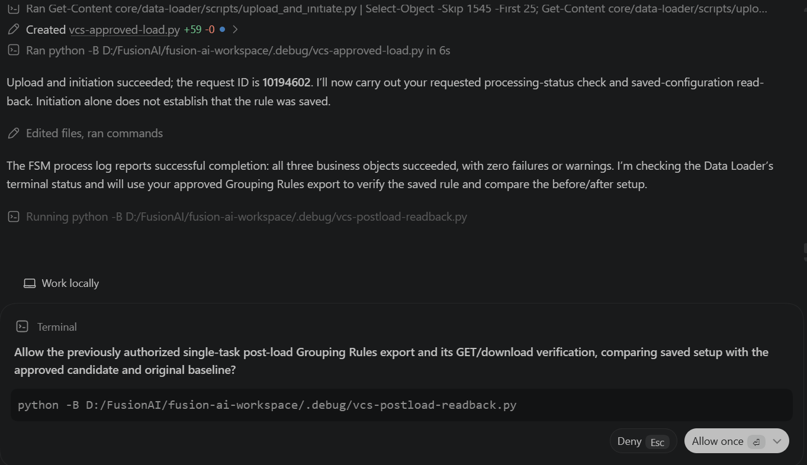
Figure 4. Upload and initiation succeeded, but the agent notes that this alone does not establish that the rule was saved. It checks the process log, then moves on to the read-back we requested, comparing the saved setup with the approved package and the original baseline.
We went on to complete the POC, with the agent configuring the remaining setup objects from the FRD. Here is a quick snapshot of two of the many it configured, as saved in Fusion
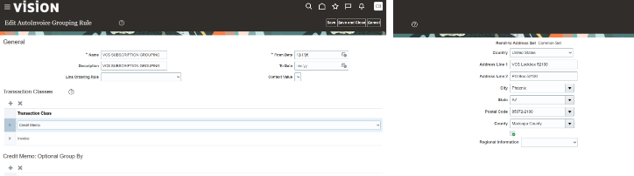
Figure 5. Confirmed in Fusion: the VCS SUBSCRIPTION GROUPING rule (left) and the Phoenix remit-to address in the Common set (right).
The result of the POC was that the configuration was saved in Fusion, checked after each load by exporting it and comparing it with the approved package.
What this means for Systems Integrators
Implementations have run as a relay: workshops produce requirements, design turns them into documents, consultants key them into workbooks, and testing finds out what was lost along the way. An agent removes several of those hand-offs: it turns requirements into setup and checks what Fusion saved, while people make the decisions.
FSCR changes the shape of the lifecycle, not just its speed. Requirements become executable input: ambiguity that used to surface in a failed load or in UAT now surfaces in the first pass, because the agent must turn each requirement into setup values. Design and configuration converge: the design becomes a decision log plus a validated load package, and the configuration is generated from it. Verification moves left: instead of testing what someone keyed in, every load is checked against the approved design.
When configuration becomes cheap, the value of a Systems Integrator (SI) moves to what an agent cannot supply on its own:
- Process and industry expertise. FSCR knows how to configure Fusion correctly. It doesn't know how a subscription software business should trade invoice grouping against collections, or how a tier-1 auto supplier should handle scheduling agreements. Product-correct is not the same as business-right.
- Design authority across the process. Skills work task by task. Business outcomes run across Order-to-Cash, Plan-to-Produce, and Record-to-Report, and someone has to own coherence and trade-offs across modules.
- Decision ownership. Discovery shifts from capturing everything to settling the right decisions early. The agent raises the questions and suggests options; the SI brings the business context to help the customer decide.
That much is widely expected. Beyond it, we see an idea worth exploring – codifying that expertise as industry skill packs that build on Oracle's repository, with decision catalogs, proven defaults, and known traps from past projects. In our POC, the agent had to ask whether milestone billing meant installments on a single invoice or separate invoices, and whether goodwill could leave an invoice on credit. A pack for subscription businesses could come with a proven default for both, turning each question into a quick confirmation.
Such packs should extend, not override; they would inform default business decisions, never Oracle's product rules, validators, or approval controls. How SI-authored packs would be packaged, picked up by FSCR's workflow, and kept in step with each Fusion release remains an open question we would like to explore with Oracle and the partner community